

Here's the thing about robot vacuums: the technology has gotten remarkably good in the sub-$300 range, to the point where spending more doesn't always mean cleaning better. Five years ago, budget robot vacuums were essentially expensive toys that bumped into your furniture and called it a day. Today? You can get intelligent navigation, self-emptying bases, and genuine multi-surface suction power for what you'd spend on a nice dinner for two. The question isn't whether an affordable robot vacuum can do the job. It's which one does the job best for your home.
We dug through specs, user experiences, and long-term reliability data to separate the genuinely useful machines from the ones that just look good in product photos. What follows is an honest breakdown of what matters, what doesn't, and which robots deserve a spot in your home.
What Actually Matters in a Sub-$300 Robot Vacuum
Before we talk specific models, let's establish what separates a good budget robot vacuum from a bad one. Because the feature lists on these things can be dizzying, and manufacturers love to highlight flashy specs that have little bearing on day-to-day performance.
Navigation technology is the single biggest differentiator. Cheaper robots use semi-random bump-and-go patterns, which means they'll eventually cover your floor, but "eventually" might mean running for 90 minutes to clean a 400-square-foot room. Better models use LiDAR or camera-based mapping to clean in efficient, methodical rows. The difference in coverage and battery efficiency is dramatic.
Suction power matters, but not as much as you'd think. Most modern robots in this price range generate between 2,000 and 4,000 Pa of suction, which is more than enough for hard floors and low-pile carpet. Where suction really comes into play is with pet hair on medium-pile rugs. If that describes your situation, prioritize models with rubber extractors over bristle brushes.
Dustbin capacity and self-emptying capability are the features that determine whether you'll actually use the thing consistently. A robot vacuum that requires you to empty it after every run is a robot vacuum that ends up collecting dust in a closet. Self-emptying bases have come down in price enough that several models now include them under $300.
Our Top Picks
Best Overall Value: iRobot Roomba i3+ EVO
The i3+ EVO represents something of a sweet spot in the robot vacuum market. It's not the flashiest option, and it lacks the LiDAR mapping of pricier Roombas, but what it does, it does with a reliability that's genuinely impressive at this price point. The Clean Base automatic dirt disposal system is the headline feature, and for good reason. This thing holds up to 60 days of debris, which transforms the robot vacuum experience from "a chore you have to manage" into something that legitimately runs itself.
The i3+ uses iRobot's Reactive Sensor Navigation, which creates row-by-row cleaning patterns without full room mapping. It's not as efficient as LiDAR, but it's a significant step up from random bounce navigation. The dual rubber extractors are excellent at handling pet hair without tangling, and suction performance on both hard floors and carpet is solid. Integration with the iRobot Home app and voice assistants rounds out a package that punches well above its price class.
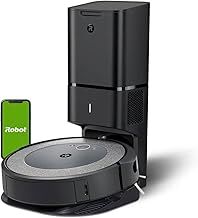
iRobot Roomba i3+ EVO
Best for Pet Owners on a Budget: Shark IQ Self-Emptying Robot Vacuum
If pet hair is your primary nemesis, the Shark IQ deserves serious consideration. Shark has long understood the pet owner market, and this robot reflects that expertise. The self-cleaning brushroll is a genuinely useful innovation: hair wraps are the number one maintenance headache with robot vacuums, and the Shark IQ addresses this by actively de-tangling during operation. It works. Not perfectly, not every time, but well enough that you're pulling hair off the brushroll once a month instead of once a week.
The self-emptying base is included at a price that undercuts several competitors, and the bagless design means no recurring costs for replacement bags. Navigation uses Shark's IQ system, which maps your home over multiple runs and improves its efficiency over time. The first few cleaning sessions will look a bit chaotic, but by the fourth or fifth run, it settles into a systematic pattern. The app allows you to schedule room-specific cleaning once mapping is complete, which is a nice touch at this price.
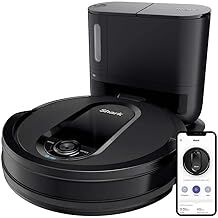
Shark IQ Self-Emptying Robot Vacuum
Worth Considering: Bissell SpinWave Pet Robot 3347
For those who want both vacuuming and mopping capability without spending more than $300, the Bissell SpinWave Pet is an interesting proposition. It's a 2-in-1 design that vacuums and wet mops in a single pass, which sounds like a gimmick until you realize how well it handles kitchen floors and entryways. The mopping function isn't going to replace a proper mop for deep cleaning, but for daily maintenance of hard floors, it adds genuine value.
Bissell's dedication to pet-specific design shows in the triple-action brush system and edge cleaning performance. It doesn't include a self-emptying base, which is a notable omission, but the lower price point reflects that. If you're in a smaller home (under 1,000 square feet) with primarily hard floors and a pet or two, this one offers a combination of features that's hard to match.
Features You Can Safely Ignore at This Price
Marketing departments work overtime to make you feel like you need every feature imaginable. Here's what you can confidently skip when shopping under $300:
- Object recognition AI: At this price, it's rudimentary at best. The algorithms aren't sophisticated enough to reliably avoid small objects. Just pick up your socks.
- "Precision" mopping systems: Dedicated mopping robots do this better. The vacuuming-first models that add a damp pad are fine for maintenance, but don't expect miracles.
- Ultra-long battery life claims: If the robot has efficient navigation, it will finish a typical home (up to about 1,500 square feet) on a single charge regardless. Battery life only matters if navigation is poor, which means you're solving the wrong problem.
- App ecosystem depth: You need scheduling, start/stop, and maybe room selection. That's it. The robots that advertise 47 app features are compensating for something.
The Self-Emptying Base Question
Let's address the elephant in the room directly. Is a self-emptying base worth it? The short answer is yes, with a caveat.
A self-emptying base transforms a robot vacuum from a semi-automated tool into something approaching true automation. Without one, you're emptying a small dustbin every one to three cleaning sessions, depending on your home and pets. That's not onerous, but human nature being what it is, the friction adds up. People stop running their robot vacuum because they forget to empty it, it gets full mid-cycle, and performance degrades. A self-emptying base eliminates this failure point entirely.
The caveat: self-emptying bases are loud. Like, "startlingly loud for three seconds" loud. If your robot runs at 2 AM and the base is near a bedroom, you'll hear it. Plan your scheduling and base placement accordingly.
Final Recommendations
For most people shopping under $300, the iRobot Roomba i3+ EVO is the safest, most satisfying choice. It combines a proven self-emptying system with reliable cleaning performance and the kind of build quality that suggests it'll still be running strong in three years. Pet owners who prioritize low maintenance should look closely at the Shark IQ, whose self-cleaning brushroll solves a real and annoying problem.
The best robot vacuum is the one you'll actually let run every day. At this price range, all of our picks clear that bar with room to spare. Pick the one that matches your specific needs, set a schedule, and enjoy coming home to cleaner floors. It really is that simple.